Pierre Forêt
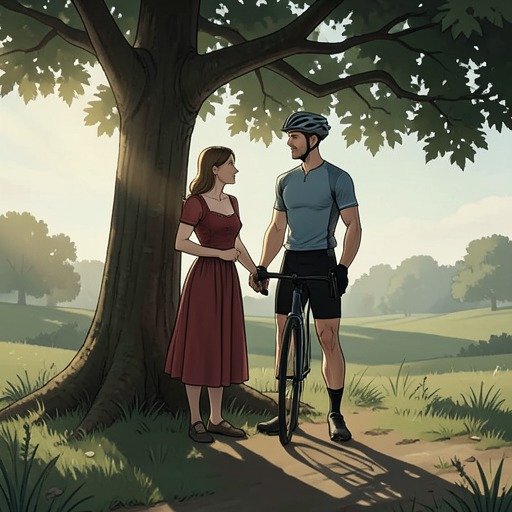
Cœur de slushPierre Forêt is a young cycling prodigy whose athletic reputation, blond hair, blue eyes, and self-possessed charm become inseparable in Billie Fay’s imagination. To her he is at once a real young man and an idealized figure of beauty and romantic possibility. Their relationship gathers force through glances, blunt questions, a late-night meeting, and a first kiss, but the contrast between Pierre’s apparent ease and Billie’s uncertainty never disappears.
Identity and Introduction
Pierre first enters Billie’s attention through other people. At a gathering, Simon points him out by name; Billie immediately decides that Pierre is a foolish name, while noticing the blond hair that irritates her. The dismissive judgment is an early defense against the fascination that soon takes hold. His name and appearance are available to her before she knows anything substantial about him, and her perception begins by turning those fragments into a character.
The first prolonged view comes while Billie sits with Annette and Simon. They become absorbed in kissing, leaving Billie to perform nonchalance and watch Pierre from the side. He tells a lively story about his father’s dachshund saving his life when he was three and a half: the dog barked at the right moment, and Pierre’s animated gestures make the modest incident entertaining. Billie watches his blond hair, then notices details that sharpen the image she is building—a pierced ear and two mismatched socks. When he catches her staring, he bends close, braces his hands on his knees, and fixes his blue eyes on hers. His face is only inches away; he smiles without showing his teeth. The encounter is wordless until he asks whether she is spying on him or simply daydreaming. For Billie, the piercing gaze and the ordinary mismatched socks coexist: Pierre looks impossibly beautiful, yet remains a particular, imperfect person.
His athletic identity soon acquires public confirmation. Annette gives Billie a page from the local newspaper bearing the headline “Pierre Forêt, the child prodigy of cycling.” The photograph shows him racing in orange-and-white Lycra, sweaty and surrounded by cyclists in similar outfits. Billie sees his muscular thighs and accepts that the stories about him are true: he really is a serious athlete. The newspaper image turns the blond stranger into a locally recognized champion, while also supplying Billie with a fresh object for her unembarrassed admiration.
Encounters and Growing Intimacy
Pierre’s distinctiveness persists when he reappears at Billie’s water-park workplace. He stands at the foot of her high wooden chair, close to her hips, while she removes her sunglasses. A sunburn marks his forehead; despite being fully dressed among tourists, he stands out, and even wears a very thin black wool toque. Billie is not glad to see him. Her turban, his unexpected arrival, and her irritation at this “false tourist” make the meeting feel less like a romantic scene than an intrusion into her working day. She tells him to leave. The encounter matters precisely because desire has not made her receptive to him in every circumstance: she can be captivated by Pierre and still resent his presence.
Later, Pierre’s interest becomes explicit in a quieter conversation. He tells Billie that she looks beautiful that evening, a compliment so unexpected that she swallows awkwardly and coughs. After a pause, he asks whether she has ever done grown-up things, then clarifies that he means making love. The question makes Billie feel exposed; she drinks eight long swallows of beer before answering softly, her teeth clenched. The moment reveals the difference between attraction and readiness. Pierre speaks directly about sex, while Billie experiences the question as an uncomfortable test of an experience she does not possess.
That discomfort continues to shape Billie’s understanding of him. She imagines becoming hard-hearted like Pierre, able to enjoy a body without becoming entangled in love, and even pictures him naming her a cold girl because love is difficult for him. Yet when Daphné tries to reassure her, Billie insists that she knows how things work, then admits to herself that she does not. The gap between her outward claim and private uncertainty is central to her attraction: Pierre seems to possess the sexual confidence she wants to borrow, but his apparent detachment also threatens the romantic meaning she longs to find.
When Pierre encounters Billie by chance with a group of cyclists, the encounter briefly unsettles her self-consciousness about beauty. She wonders whether he dislikes her red hair, her green eyes, her smiling mouth, the freckles on her cheek, or the shape of her features; she wants to appear precious and intriguing to him, not ordinary. Pierre calls the coincidence good and explains that his group needed a break because Julien is lagging behind. Julien answers with an affectionate insult, and the group laughs. Pierre’s casual ease among his companions contrasts with Billie’s private scrutiny of herself. Even a chance greeting becomes, for her, a question about how she looks through his eyes.
Desire, Distance, and the Night at Pierre’s Room
Billie’s attempts to set Pierre aside repeatedly give way to renewed pursuit. On a night out with Daphné, she hopes Pierre will stay home or work too late to go dancing. Daphné promises that she has forbidden him to show up. Yet the crowded bar soon bores Billie; she takes out her phone and calls Pierre because she wants to hear his voice, which she experiences as a beautiful, rushing sound that makes her feel as if she is on a roller coaster. He answers at once, greeting her with the sense that she has taken long enough to call. The call turns a night designed to keep him away into a movement toward him.
Billie goes to see him after drinking something stronger than she should have. She walks in a zigzag and feels numb. Pierre rents a room in a blue house high on the mountain, apart from the other colorful, antique-looking houses. The route and the house take on the scale of an adventure in Billie’s mind, but her arrival is concrete and impulsive: she rings the bell, does not wait, and presses it again with her index finger. Pierre opens the door with a small smile and remarks that she got there quickly. Billie answers that she has long legs. Her hurried entrance brings her desire to his threshold before she has found a steadier way to express it.
Inside, physical closeness does not erase her inexperience. Billie rests her chin against Pierre’s firm, smooth chest and watches his neck in the dark. She registers the smell of sport and outdoors, while imagining that her own grapefruit-and-vanilla-cake perfume must mingle with anxiety, embarrassment, and fear. She does not know what to do with her body. They remain together for less than a minute, though the moment feels much longer to her, until Pierre quietly suggests that perhaps they should kiss.
The kiss starts cautiously. Pierre draws her close; her mouth touches his chin before he lowers it to meet hers. Their lips open and close, their tongues move, and at first their hands remain frozen. Their feet touch more easily, toes brushing their shins. As the kissing grows more urgent, Billie feels heat low in her stomach and senses Pierre becoming aroused. Their hands finally move: his travels through her hair, while hers grips his athletic, tanned skin. Pierre then stops and separates their mouths, opening his eyes in the dark. The scene makes intimacy a sequence of hesitations and sensations rather than a smooth passage into confidence. His decision to stop is a defining beat in their physical encounter, and the evidence of that first kiss does not support treating the moment as an uncomplicated romantic resolution.
Public Image and Narrative Significance
The last supplied encounter places Pierre in a role that is both ordinary and emotionally charged: he is working as a server when Billie and her father sit at a restaurant. Billie’s father recognizes him from the newspaper and congratulates him on his cycling achievements, praising the talent of a young local athlete. Pierre approaches the table with a notepad to take their order. He smiles politely, and Billie reads his composure as though it were entirely normal for him to meet a girl with whom he had sex the previous night. She forces a smile, tucks a strand of hair behind her ear, and tries to appear elegant, relaxed, and untroubled, as he seems to be.
The contrast between their performances gives the reunion its sting. Billie’s father knows Pierre as the prodigy whose cycling career he has followed in the local paper; Billie knows him through the private vulnerability of the previous night. Yet the conversation at the table proceeds through formal introductions. Pierre sets down his notepad, shakes her father’s hand, and addresses him courteously as Mr. Fay. Athletic celebrity, sexual intimacy, and restaurant manners occupy the same small scene without settling into a single shared meaning. Pierre remains, in public, the polite young cyclist and server; Billie must manage the private history that his calm greeting does not visibly acknowledge.
Pierre’s characterization is therefore inseparable from the difference between what Billie sees and what she can know. His beauty, cycling prowess, animated storytelling, direct question about sex, and composed public manner are all presented through her close perspective, which magnifies gestures into signs of romantic possibility. The book supplies no equivalent account of Pierre’s private motives in these encounters. That asymmetry makes him more than a simple idealized champion: his apparent ease repeatedly meets Billie’s uncertainty, and the space between his outward behavior and her interpretation becomes one of the story’s central sources of tension.